Staff review
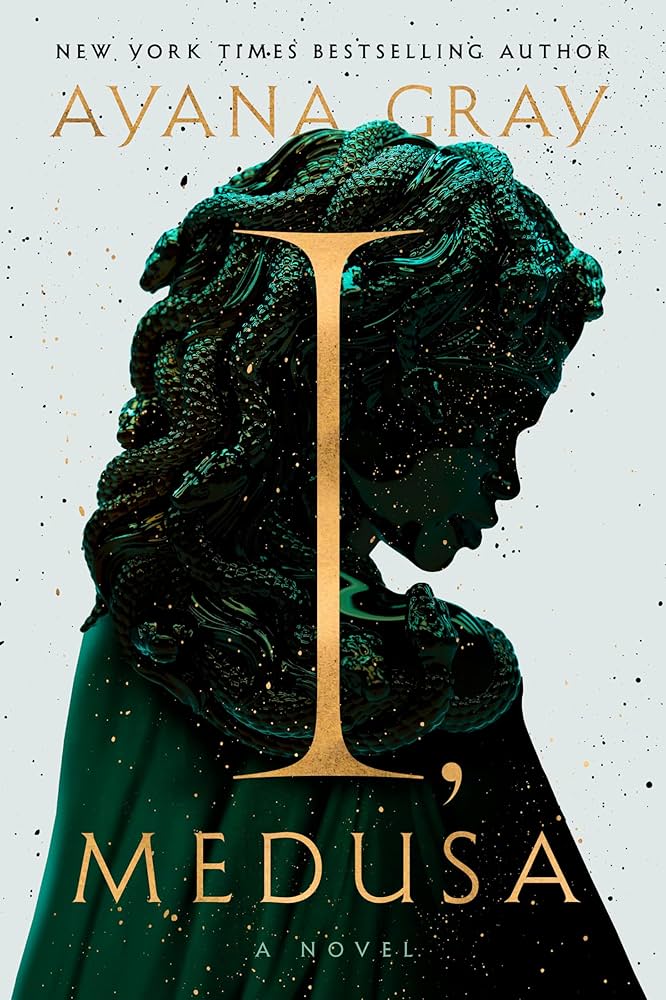
I, Medusa

6.5
Staff write-up
The Rev
I love mythology. The modern interpretations are hit or miss. So, did I love I, Medusa? No, but it wasn't bad.
I actually enjoyed the early bits a lot. The story feels fresh and easy to follow while diving straight into the classic mythology. The narrative structure works well. There is decent tension, solid family building, and a terrifying scene fueled by a sexual pest early on that sets the events of the rest of the novel in motion.
Medusa is the youngest of three sisters who are all of marriage age. When a suitor named Maheer proposes to her sister, things look bright. But when Medusa finds out he is mean, abrasive, and belligerent, she intervenes to break it off. Maheer sexually assaults her. In defense of herself, Medusa kills him.
Because Maheer is a relative of Ares, the God of War, his death is investigated by Athena. Medusa confesses to the crime. Instead of anger, Athena feels respect and sympathy. She spares Medusa and brings her to her temple to train as a priestess.
All of this is great. There are clever mythological Easter eggs hidden in the text, and the prose is tight. Then we move to the temple, and the author seemingly forgets what book she is writing.
The style abruptly pivots into Young Adult territory. It essentially turns into Hogwarts in ancient times. Tasks pop up and are solved instantly. Events happen without any fleshed out descriptions. The story becomes completely linear and basic. Yet, the book still retains a harsh, gritty edge when describing the prior physical assault. It is a case of tonal whiplash. You have a childlike naivety brushing right up against deep, adult trauma. Which is fitting for Medusa as she's entering adulthood, but ok not entirely sure that was the authors intention.
Halfway through this 300 page book, we are still character building. There is no central conflict and no main antagonist. We just have a game of chess set up on the board between Ares, Athena, and Poseidon, but nobody is actually moving the pieces. The pacing begins to slog.
During the second trial, the priestesses have to do a craft. Medusa is not handy. Then it hits her. Her hair. She can braid and design hair with stunning intricacy. This is actually brilliant. It highlights that Medusa is a woman of color with hair different from the common, whitewashed Greek portrayals. It is her realizing her own self worth, and it serves as fantastic foreshadowing for her eventual snake hair.
But the author does nothing with it. None of this is elaborated on. No weight is given to the moment. The underpinnings of brilliant social commentary are right there on the page, but the embers are just left smoking instead of catching fire.
As the story progresses, it becomes crystal clear that this is all an allegory for the #MeToo movement, admirably. When Medusa finally gets turned into a stone cold monster, the events leading up to it are victim blaming and grooming personified. Poseidon uses his status and power to manipulate her, striking before she can even think to say no. Her subsequent "trial" is just Zeus asking if she explicitly said "no." Athena takes the assault as a personal betrayal and strips away Medusa's beauty and humanity.
It is a powerful message, and I feel bad criticizing it. But because it bounces between YA simplicity and heavy trauma, it feels a little too on the nose.
The final act completely falls apart. Medusa and her friend Apollonia leave their island for a new life. But when the same perverted power dynamic follows them there, Medusa refuses to sit idly by. This is a stark departure from the original myth, framing Medusa as a misunderstood antihero. It all happens incredibly fast.
Then we get to the final kill. Let us stop and think about the logic here for a single second. Why did Medusa feel the need to sneak in, haul a heavy human body all the way to the waterfront, and stage a complex cover up? Just stab the guy in the temple and run away! The author clearly just wanted to force Medusa to use her stone powers I get caught, so she wrote a completely nonsensical scenario to make it happen. The act itself act as a cheap MacGuffin.
Then we reach the epilogue. Her legendary destruction and beheading at the hands of Perseus is glossed over in one page. Yes, the book is about her life, not her death, but it still stings to have the most iconic part of her mythology rushed through like an afterthought.
Overall, the story is competently written. It is a solid example of modern allegory mixed with ancient myth. But it teeters entirely too much into simple YA territory for my liking. It was not written for me, and that is fine, but it still failed to live up to its own potential.
Same vibe
Related Revs
-1.jpeg)
.jpeg)

Same desk



-1.jpeg)