Staff review
One World Under Doom
5
Staff write-up
The Rev
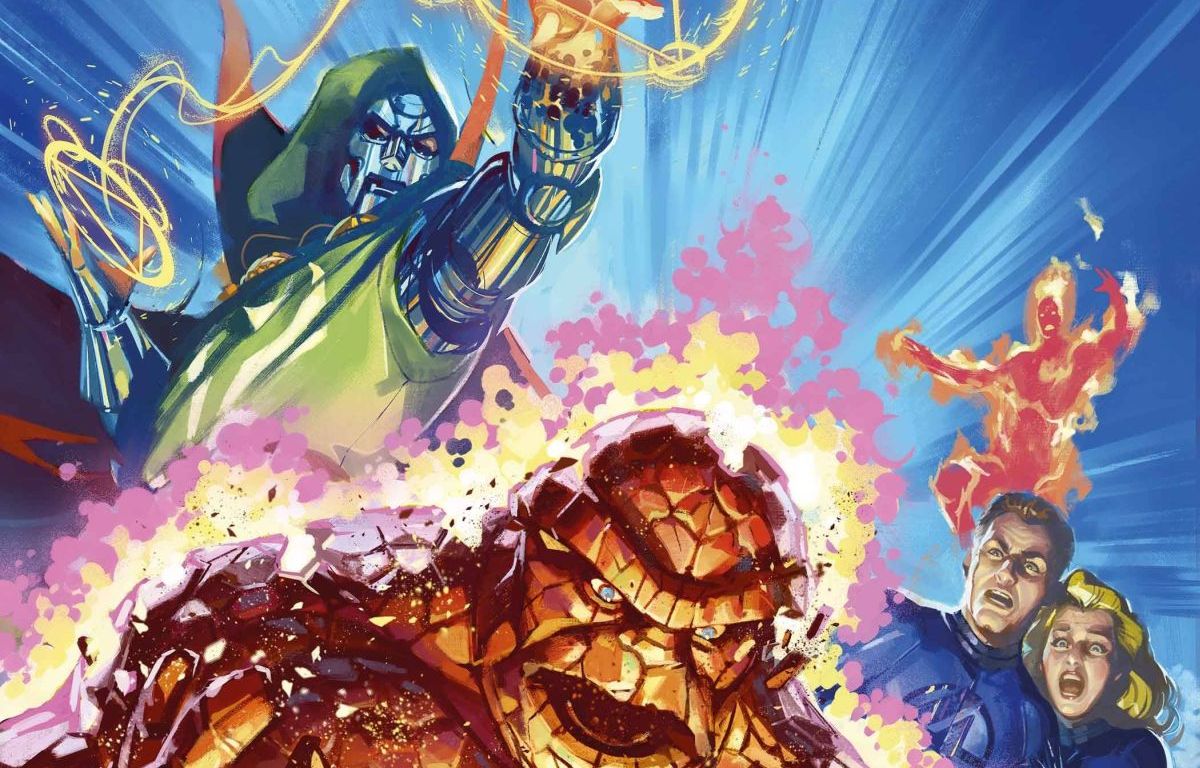
One World Under Doom asks a genuinely interesting question. What if an evil, untrustworthy ruler took over the world and things actually started to get better? Universal healthcare, free education, an end to war. No visible downside except some basic rights and consequences that land a little heavier than you'd like. It's the kind of premise that should make for a great story.
But the heroes, well, most of them, know something is off. Thor rolls over almost immediately, which the book frames as echoing Doom's parallel to Odin. Except Odin, whatever his faults, wasn't actually evil. It's a smart comparison that the story unfortunately doesn't do much with.
The tie-ins are mostly tired, unnecessary, or if necessary, boring. Which is pretty much my standing reaction to Fantastic Four comics in general. Despite several attempts over the years I've never really gotten into them, so I came into OWUD without a solid grip on the current state of Marvel's first family. And that's part of the problem. The onboarding is minimal. The little catch-up blurbs at the start of each issue do the bare minimum.
Doom is Sorcerer Supreme now, okay. Valeria and Franklin are somewhere in preteen territory, fine. Johnny Storm is rocking a Hulk Hogan mustache for reasons nobody explains. And then there's the Doom and Valeria relationship, which is odd enough that it deserves more than a shrug.
Valeria Richards is Reed and Sue's daughter, not Doom's child. Doom is her godfather, and their bond is one of the more genuinely complex relationships in his corner of the Marvel universe. Doom does have a biological son. The Valeria relationship is earned lore, but OWUD doesn't do nearly enough to sell it or rationalize it.
Te main story treads water while the central Fantastic Four tie-ins focus on Ben Grimm trying to get his powers back, because Doom cured him, something Reed Richards never managed to do. But when any member of the Four goes missing, the others start losing their powers too, slowly, for vague reasons. They get them back by casually time-traveling to the Big Bang to grab some extra-strength radiation, because apparently regular radiation won't cut it. Again, no explanation given. That sounds like it should be incredibly dangerous and difficult. It is not. It is super easy, barely an inconvenience.
Repowered, the FF return to the present and discover that Doom has been leeching life energy from the people of Latveria to fuel his power, keeping them in a kind of ethereal stasis. Half the world thinks this is a reasonable trade for a slightly more comfortable life. And here's where OWUD accidentally becomes the most relevant comic of 2025 without quite having the nerve to commit to it.
This is the authoritarian bargain laid out plainly. Give up a little freedom, gain a little comfort, and trust that the man in the monster in chief has your best interests at heart. Sound familiar? We're living through a real-world version of this argument right now, where entire populations are being asked to accept concentrated power in exchange for promises of efficiency, security, and results.
The genius of Doom's world takeover isn't the magic or the muscle. It's that he makes the math seem reasonable. Ryan North clearly sees this parallel. The problem is he baulks. The story acknowledges the deal being made but never really interrogates it, never sits in the discomfort long enough to say something meaningful about why people accept it.
To be fair, not everyone does. There are resisters. Heroes who aren't buying it regardless of the headline numbers. And that's the hopeful thread buried in here, that some people will always pull the alarm even when the lights are on and the heat works fine. It's just frustrating that OWUD treats that resistance as a plot mechanic rather than the actual point of the story. This should have been the spine of the whole event. Instead it's a backseat between action sequences and pointless tie-ins.
Everything comes to a head when Doom explodes his armor in battle and very deliberately doesn't kill any of the assembled heroes. He wounds them. Carefully. Except for Valeria, who he morally wounds in the chaos. Doom is devastated. He takes her body to the Living Tribunal and trades his own life to bring her back. It's the most emotionally effective moment in the entire run, even if it takes nine issues to get there.
The epilogue gestures at something interesting. Doom leaves his estate to one who can prove capable of handling it. Would that kind of power corrupt Valeria? With Latveria's defenses suddenly gone, do neighboring nations move in? These are great questions. OWUD does not answer them. Instead we pivot to a treasure hunt through Doom's dungeon vaults, which feels less like a conclusion and more like a soft launch for future titles.
And then it's over. Nothing has materially changed. No lasting consequences are visible. We're essentially back to status quo, Doom will be back soon enough, and the whole thing evaporates. One World Under Doom had the bones of a great Marvel event and the execution of a mid one. A story that could have been a tight, pointed piece of social commentary instead dips a toe into its own potential and retreats. Muddled by pointless tie-ins, rushed at the finish line, and leaving almost no fingerprints on the Marvel universe it promised to reshape.
The T-Rex was cool though.
Same vibe
Related Revs
-1.jpeg)
-1.jpeg)
.jpeg)
.jpeg)
Same desk
-1.jpeg)