Staff review
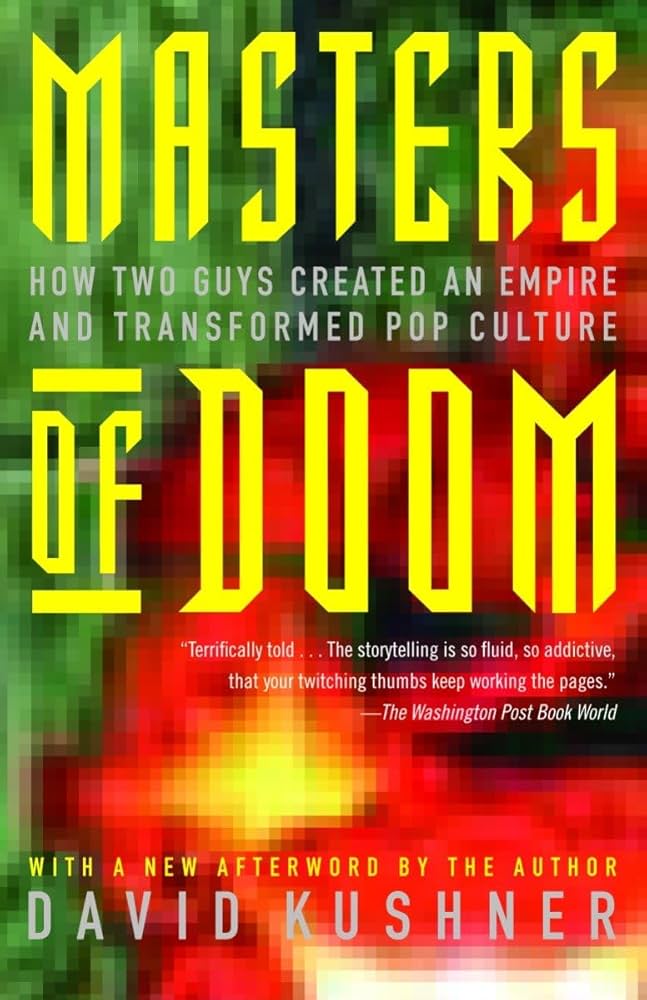
Masters of Doom: Hw two guys created an empire and transformed pop culture

9
Staff write-up
The Rev
Masters of Doom is a fascinating read looking back on a simpler time through the eyes of two dudes who could see much further than the established programmers sitting at the top of the mountain. Following the story of the Two Johns, John Carmack and John Romero, we see a perfect dichotomy. Carmack is logic and completely lacking in ego, acting entirely as a relentless problem solving force. Romero is all showmanship, aesthetic, and bold artistic vision.
Similar to other rags to riches corporate biographies like Shoe Dog, but oozing with way more grungy authenticity, we follow the Johns as they set out to revolutionize the failing video game world. What follows is a nostalgic, blood soaked romp up the ladders of video game superstardom.
We follow the guys as smart, geeky, and troubled kids. One psychological evaluation famously labeled a young Carmack as a walking brain with legs that lacked empathy. They were wildly ambitious. Hopping from studio to studio, they knew their big break was just around the corner. Pulling heavy inspiration from movies like Tron and WarGames alongside the dense programming manuals of yesteryear, we see exactly what it took to create the most influential game and multiplayer mode in history.
As the id Software team begins to take shape with Tom Hall and Adrian Carmack joining the fold, we learn more about the raw innovation needed to reach their ultimate destination. Figuring out smooth side scrolling graphics for PC, animated tiles, and other technical leaps show the sheer ambition this ragtag group needed to progress past making small, monthly disposable games. Carmack was essentially building a flawless, foundational architecture completely from scratch.
The birth of Wolfenstein 3D puts the mindset of id Software on full display. The creativity that was lacking everywhere else in the industry oozes from this team, showing off what a passion project actually looks like. They added more intense sound effects and better hidden secrets. When told to tone down the violence by outside forces, they rebelled by adding more gore, more blood, and the infamous kill cam.
Massive innovations follow. The most important is Binary Space Partitioning. This rendering trick only draws what the player's viewport is actively looking at, allowing Doom to push the boundaries of speed and efficiency. No one had done this before. There was no path to follow, only a dense technical paper and raw theory. The team pioneered a technique that bypassed previous processing limitations to create a richer, lightning fast experience that became the cornerstone of all future game development. Innovation was not the only thing happening, though. Team dynamics shifted with Tom Hall being forced out and Sandy Petersen coming in. Sandy brought sheer enthusiasm and a veteran tabletop gaming talent to the team, seriously ramping up the cerebral aspects of the level design.
Then we get the ultimate breakthrough. Deathmatch. Never before had player versus player combat over a network been done, much less multiple players blasting away at each other simultaneously. With the addition of scorekeeping and tracking lives, you had the single greatest game mode ever created unfolding right before the team's eyes in real time. They shaped it as they played, modifying the code based on first hand testing to maximize the fun. We finally had human brains battling human brains instead of just fighting predictable computer intelligence.
After Doom melted the world and the team pivoted to Quake, we see how the crushing stress of success impacted them. Infighting, obsession, and strained friendships were the ultimate rewards for their massive success. Coupled with the next wave of moral panic lawsuits and intense pressure from high profile senators and even the President, id Software was in a bad place. The media went on a constant witch hunt, looking for answers anywhere other than bad parenting. They focused on id as the true successor to Mortal Kombat and tried to blame them for real world tragedies like Columbine. Things were looking incredibly bleak. Carmack took it all in stride with cold logic, essentially telling the government to prove it. Romero took it incredibly personally. The fate of the remnants of the gang after Quake is unfortunately glossed over. However, the ride to get there is absolutely thrilling. There is really nothing to complain about here unless you are looking for a deeply technical programming textbook. It only goes slightly below the surface level regarding the actual programming, but that keeps things moving at a nice, highly readable clip.
Doom did not just influence other games. Carmack and Romero created the infrastructure and the entire culture of modern gaming. Now, all that is left to do is dust off Doom II and give it a run through. Never forget IDDQD. God mode forever.
Same vibe
Related Revs

-1.jpeg)




Same desk


-1.jpeg)